Left to right: silver car in bright direct light and silver car in shadow.

Left to right: silver car in bright direct light and silver car in shadow.
December 17, 2025
Silver and grey paints shimmer because metallic flakes reflect light like tiny mirrors. Depending on lighting, those flakes scatter light directly or at an angle — so the same paint can appear brilliant in direct light and muted or darker from the side, just from light shifting.
Ever notice how a silver or grey car changes personality as it rolls from sunlight into shade? That’s metallics at work: thousands of tiny flakes suspended in the paint, each catching and returning light. The effect is dazzling — and it also explains why silvers can seem to shift between panels. It isn’t different paint, it’s the same finish playing with light. That’s why we explain how silver/grey metallics and pearls work — so you understand what makes them distinctive, and what to keep in mind as an owner.
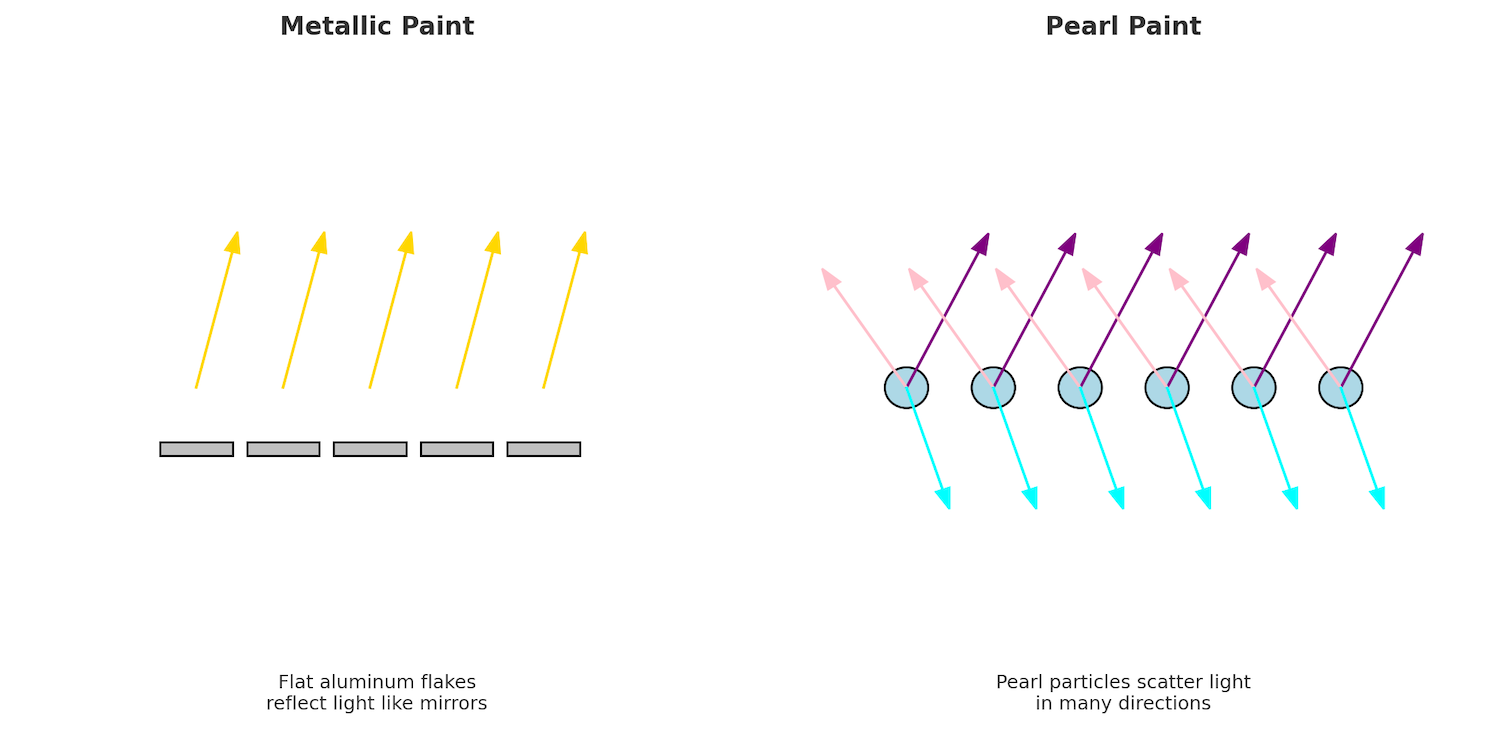
Metallic vs. pearl. In metallic paint, flat aluminum flakes reflect light like tiny mirrors, producing a crisp, directional sparkle. In pearl paint, mica or ceramic particles scatter light in many directions, creating a soft, diffused glow with depth.
When you look at a silver or grey metallic panel straight on, the flakes are reflecting light directly back at you — that’s the “face,” and it’s why the finish looks bright and even. Tilt the panel or shift your view by walking 45 degrees sideways, and suddenly those same flakes reflect light in different directions, so less returns to the eye — that’s the “flop,” and the color can appear darker or muted. It’s the same paint, but your perspective and the angle of the flakes relative to light change what you see.
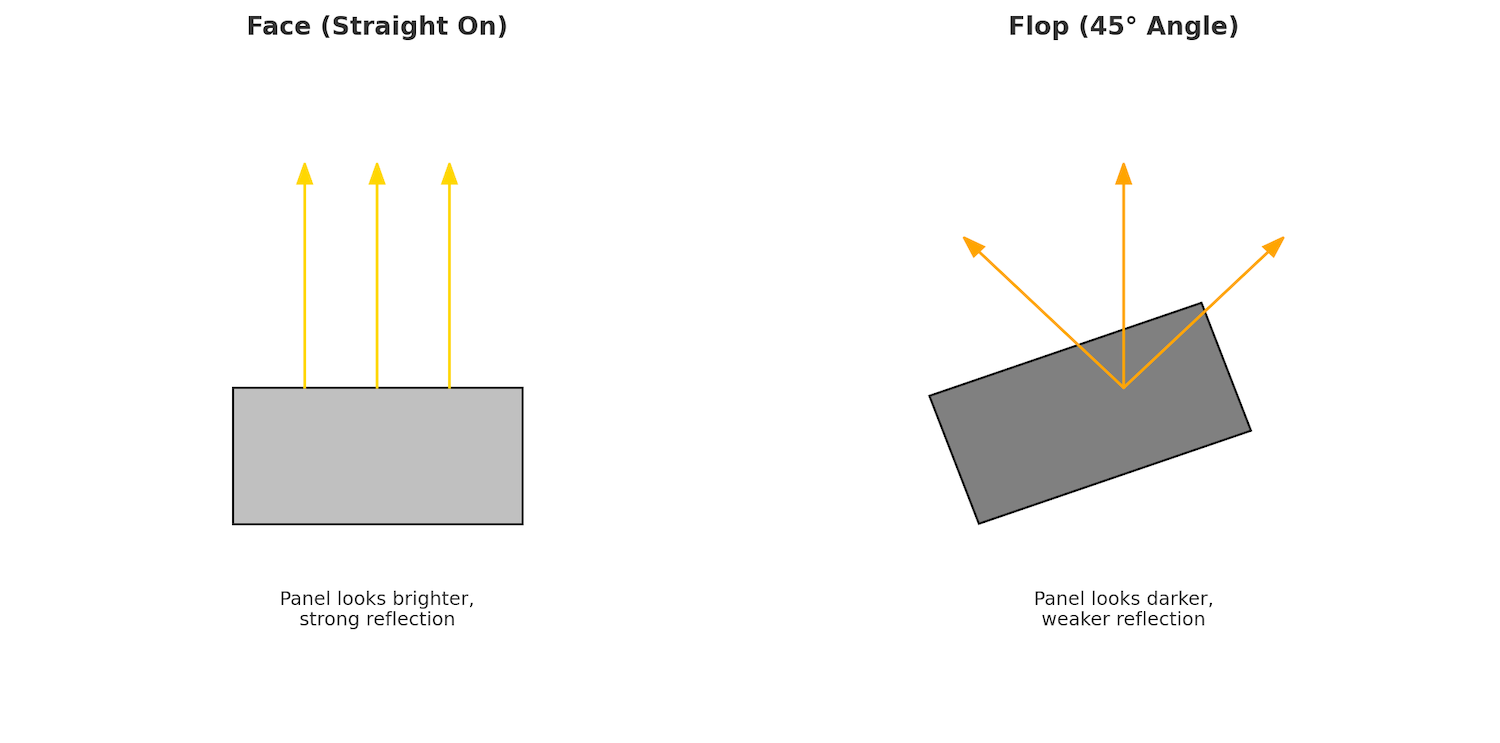
Face vs. flop. Viewed straight on (the “face”), light reflects strongly back to the eye, so the panel looks brighter and more uniform. At a 45° angle (the “flop”), light scatters in different directions, making the panel appear darker or slightly shifted in tone.
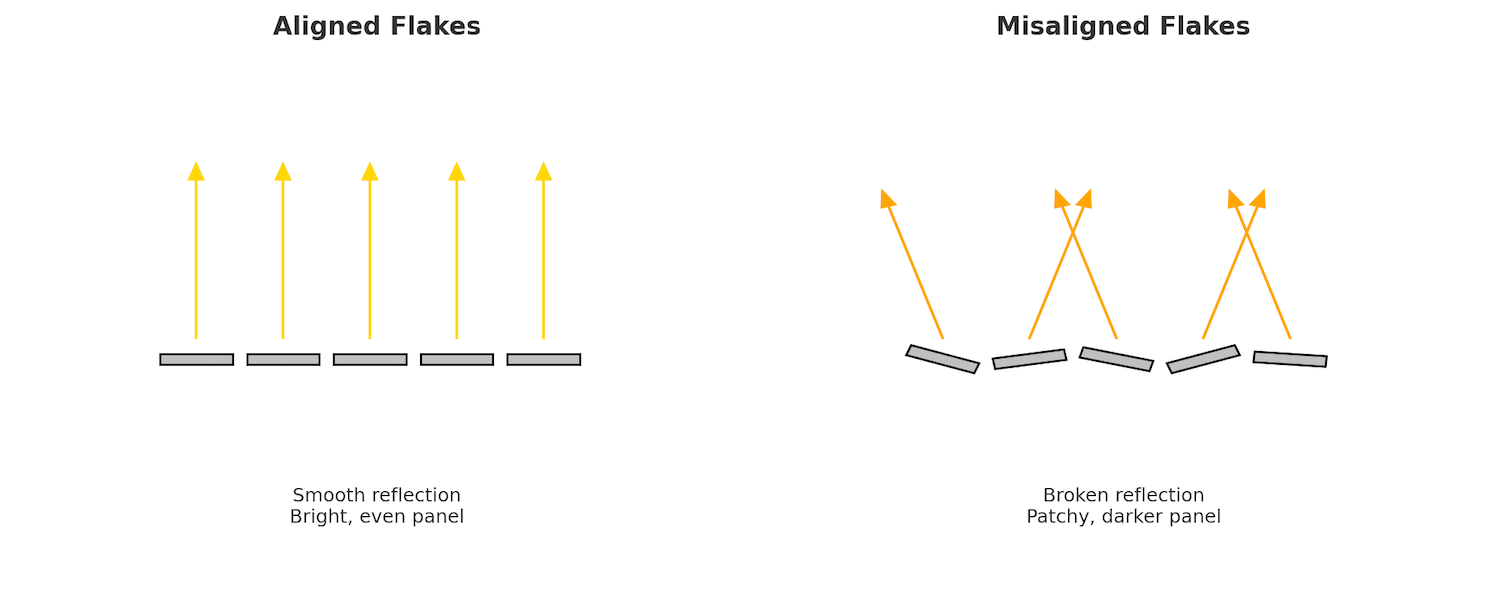
Aligned flakes vs. misaligned flakes. Aligned flakes act like an wall of aligned mirrors—they bounce light back the same way, so the panel looks smooth and bright. Misaligned flakes behave like a carnival Hall of Mirrors—each tilts differently, breaking up the reflection and making the panel look patchy or darker.
For DIY repairs, the technique is the same as the factory. Apply final light misting passes (control coats) of paint to help the flakes settle in line instead of stacking or clumping. The effect is a finish that shifts naturally with light and angle — just like the factory intended.
Here’s a 1 minute video from our technician showing exactly how he applies control coats: Control (or drop) Coat Explained→
Ever noticed how a soap bubble shifts from blue to green to pink as it floats? That’s iridescence — light waves interfering with each other as they bounce in and out of thin films.
Pearl particles in automotive paint use the same principle. They bend and scatter light so the finish seems to glow and shift subtly with angle. Paired with metallic flakes (which reflect light sharply), they give silver and grey paints their signature “alive” look — part sparkle, part shimmer.

Soap bubble showing iridescence (Photo by Marc Sendra Martorell on Unsplash).
If your silver touch-up looks bluish before applying, that’s normal. In the bottle, pigments and metallic flakes are still suspended in solvent. The liquid layer bends and scatters light in ways that make silver lean cooler — often with a blue cast.
When applied wet, the same optical effect happens: the solvent layer shifts the reflection before it evaporates. Once dry, the solvent is gone and the true silver tone shows through — the paint hasn’t changed, only the way light travels through it. It’s a quirk you’ll notice on the test card — bluish at first, silver once it sets.
What is metallic “flop” and why does it matter in silver paint?
Metallic “flop” is the change in brightness and tone seen when silver paint is viewed from different angles. Viewed straight on (the face), metallic flakes reflect light directly, making the panel look brighter. At a 45° angle (the flop), light scatters, so the paint appears darker or slightly shifted in tone.
Why do silver or metallic colors look different online than in real life?
They look different because metallic finishes can’t be represented accurately on a screen. Digital swatches are created using RGB light, while real automotive paint relies on physical metallic flakes and pigments to reflect light. Some websites add a light overlay to suggest sparkle, but this is only a visual approximation. Viewing a paint sample by code on a test card shows how the finish actually behaves in real light.
Is grey paint easier to match than silver?
Grey metallics usually read a little softer than bright silvers, since the flakes are toned down. The application technique remains the same though. Apply the final coats of paint as control coats.
Why do some silvers read warmer or cooler?
Differences in pigment undertone, flake size, and clearcoat tint (or haze) give “Bright Silver” a colder, crisp sparkle, while “Pewter Grey” reads more muted or khaki in tone. Yes, flake size can be fine, medium, or coarse.
Watch: Factory-accurate silver and grey mixing demonstrations from our technicians.
Toyota Classic Silver Metallic (1F7) — OEM Formula Color Mixing
Honda Urban Gray Pearl (NH-912P) — OEM Formula Color Mixing
Silver & Grey Mixing Playlist: Watch the full playlist on YouTube →
Discover more stories exploring color — and the allure and armor of automotive paint.