
Blue automotive paint: Transparent pigments at work
Blue car paint needs more coats because its pigments are naturally transparent. Smaller and lighter, they scatter less light and let more pass through. That transparency is also what makes blue glow so vividly — but only after multiple layers create depth.
Defined by depth rather than coverage, blue paint gets its visual impact from how light travels through the color layers, creating a brilliance that only emerges under the right conditions. Long prized as rare in art and history, blue still carries that same allure on the road today — which is why we explain how blue works, so you understand what makes it distinctive, and what to keep in mind as an owner.
Blue pigments punch above their class
The transparent nature and size of blue pigments makes them light in weight. Other colors are heavier. The difference in weight means that blue pigments, the featherweight of colors, can float away into the air when sprayed from too far away, and fail to land on the painting surface.
For the color pigments to stay in the correct ratios of their paint formula, they all have to land on the surface, not just some of them. When other color pigments in the paint formula such as white, black, red or yellow do land on the painting surface, and blue doesn’t, the integrity of the paint formula is affected. This imbalance affects color match. A blue color can go greyish or greenish, for example, if the blue pigments in the paint formula float away in an aerosol repair due to excessive spray distance.
Correct spray distance = color fidelity
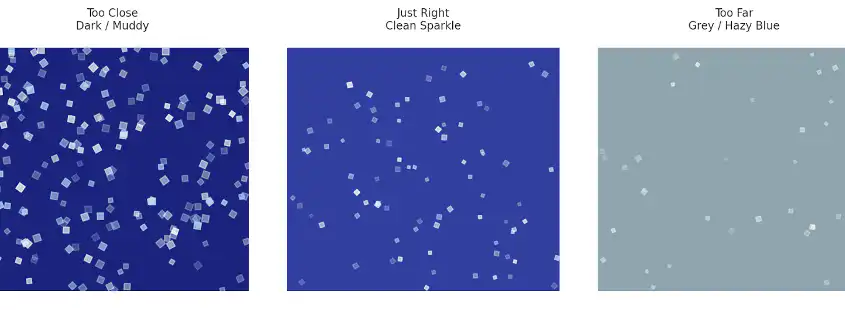
Infographic emphasizing how spray distance affects blue automotive paint color. Three side-by-side squares illustrate pigment distribution: the left labeled “Too Close – Dark/Muddy,” the center “Just Right – Clean Sparkle,” and the right “Too Far – Grey/Hazy Blue.” The image demonstrates how spraying too close or too far changes tone and clarity by altering pigment coverage and reflection.
When blue does land its punch, it’s a knock out
Getting the blue pigments onto the surface isn’t so hard either. Simply verify your spray distance and the integrity of the color match by doing a test before making the repair. Spray a test on a card at 6–8 inches and check that it matches your vehicle in natural light. With a matching painted test card, it’s just a matter of repeating the same spray method on your car. Because the pigments are transparent, blue usually needs 4–5 coats to achieve full depth. This isn’t a flaw — it’s how the sparkle builds. Each layer adds richness until the color reads as one unified, factory-matched finish.
Blue is rare in nature and in paint
Blue doesn’t just act differently on a car panel — it’s always been different. Unlike earthy reds and yellows that can be dug straight out of the ground, true blues are almost never found ready-made in nature. That scarcity made blue pigments precious. In the Middle Ages, ultramarine ground from lapis lazuli was worth more than gold, reserved for the most sacred subjects, most famously, the robes of the Virgin Mary in paintings. Scarcity gave it meaning: blue came to stand for the eternal, the divine, and the rare. And just like today’s automotive pigments, ultramarine was transparent. Artists had to build it up in thin layers to make it glow — the same way blue paint on a car only shows its depth when layers of pigment stack up.
How different blues behave
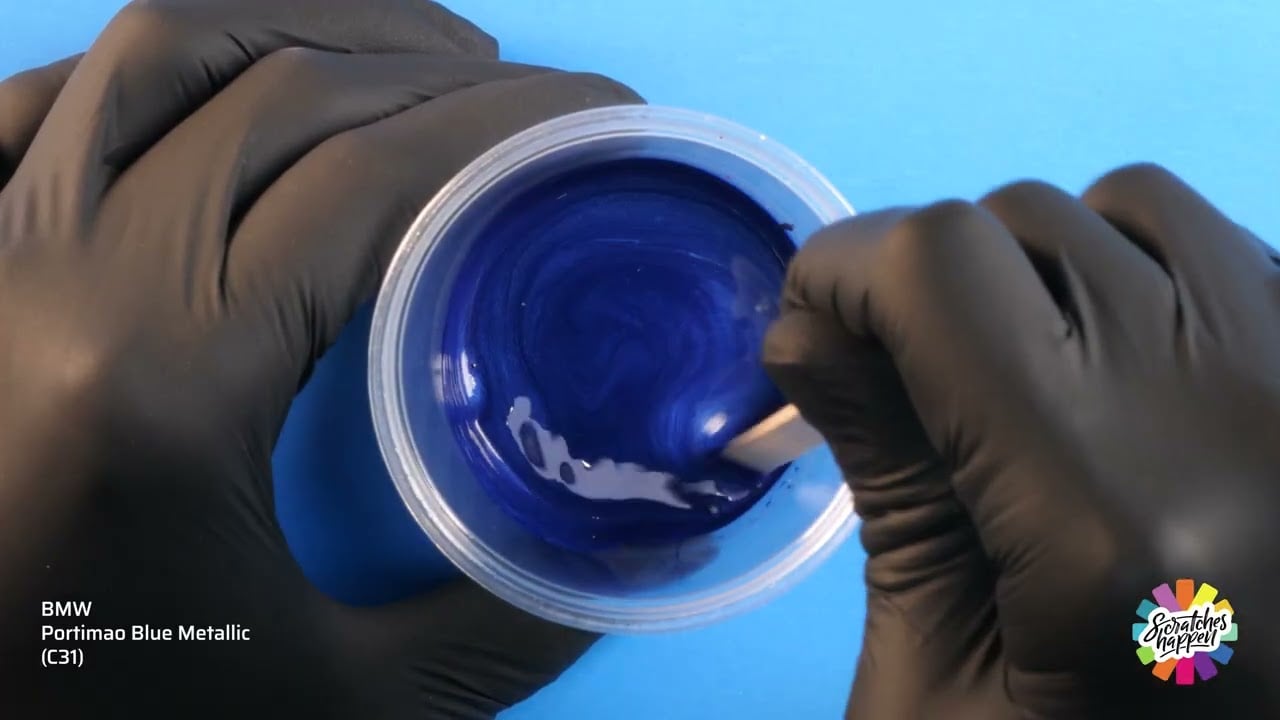
Not all blues cover the same way. A deep metallic like BMW Portimao Blue Metallic (C31) needs careful spray distance so its vivid sparkle lands evenly. Compare that with Ford Lightning Blue Metallic (N6/M7365A) — a bold metallic blue with a relatively coarse-flake effect, often appearing vivid electric blue in direct sunlight and deeper navy in shade. Portimao Blue Metallic (C31), however, delivers a finer metallic sparkle and a smoother shimmer under varying light angles, with less dramatic color shift.
Blue automotive paint — at a glance
- Spray Repairs: Blue’s lightweight pigments need even lay down — plan on a steady motion at the right distance so the color builds evenly.
- Brush Repairs: The same principle applies — it’s not about heavy coverage, but enough thin coats so the layers add up to the right depth.
- Layering: Whether spray or brush, expect 4–5 light coats; that’s how blue develops its full sparkle.
- Lighting: Always check color in daylight — natural light shows blue automotive paint’s depth better than garage lights.
Spray-out panels show why blue needs more coats to achieve full sparkle
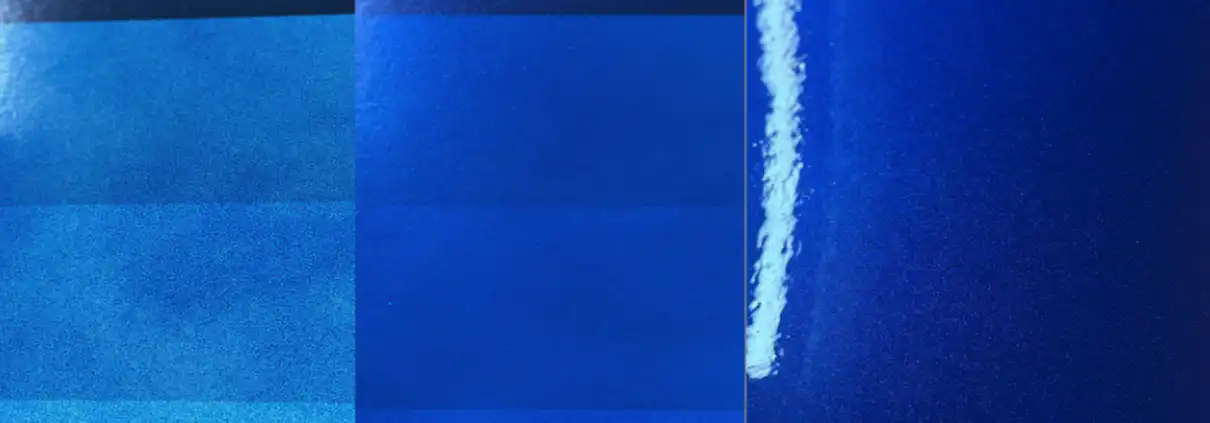
Spray-out panels created by our mixing technicians show why blue needs more coats: the first layers look light and thin, but as coats build, the color deepens into a vivid, glowing blue.
Blue paints just work differently. Their transparency means every layer shows, and when those layers build evenly the result is unmatched brilliance. That’s why we explain how each color works — so you understand what makes it distinctive, and what to keep in mind as an owner. Whether in art history with ultramarine and lapis lazuli or in today’s blue automotive finishes, the truth is the same: blue has always needed layering to show its true color.
FAQ: Blue automotive paint
Sunlight is full-spectrum, with more energy across shorter wavelengths — the same part of the spectrum that makes blue visible to our eyes (around 450 nanometers). Because blue pigments are naturally transparent and scatter less light, layering shows more clearly under direct sun. In garage lighting, which lacks those shorter wavelengths, the color can appear duller or shifted. Step outside with your test card and you’ll see the pigments reveal their true depth.
Purples are made using the same transparent blue pigments, mixed with red. Since blue pigments scatter less light and transmit more through the layers, purple finishes inherit that same behavior. Under daylight (rich in short wavelengths), purple looks vibrant. Under indoor light, with fewer blue wavelengths, the red portion dominates — which is why purples can shift toward maroon or brown.
You might. Because blue toner pigments have less hiding power, they’re usually built in 4–5 light coats. Plan for layering to achieve coverage.
Related mixing videos (blue series)
Watch: Factory-accurate blue mixing demonstrations from our technicians.
Ford Lightning Blue Metallic (N6) — OEM Formula Color Mixing
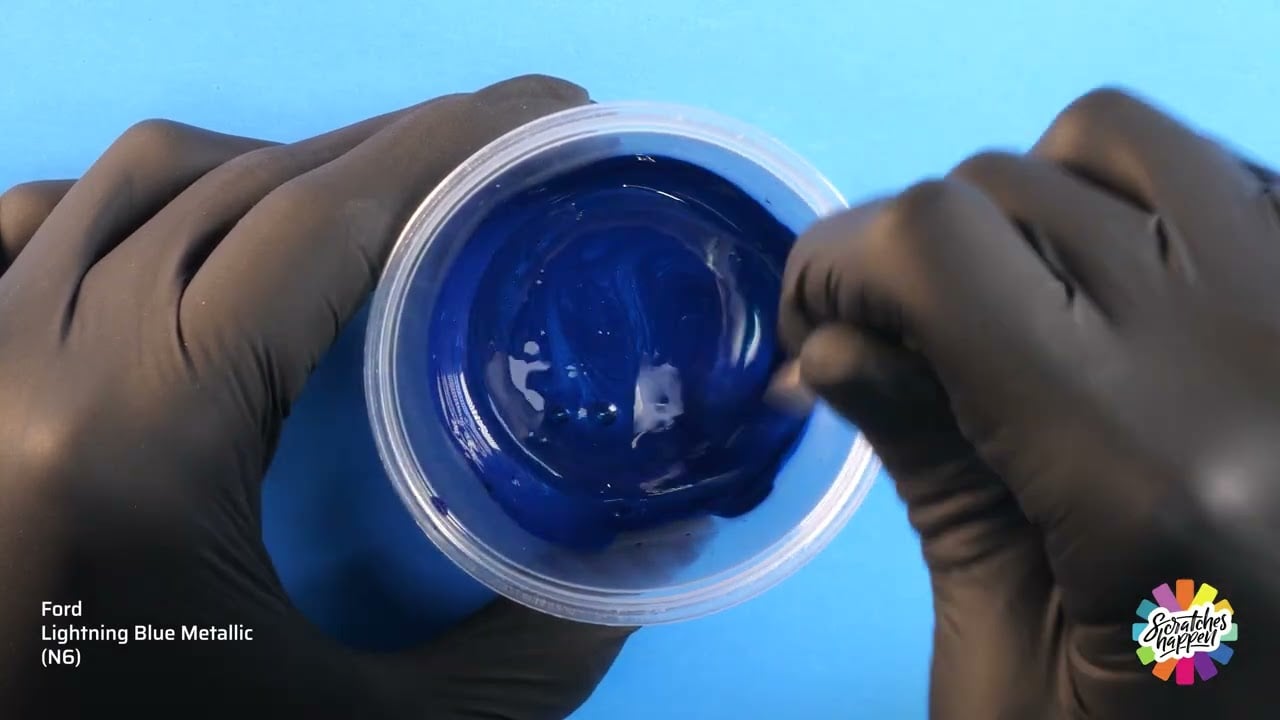
BMW Portimao Blue Metallic (C31) — OEM Formula Color Mixing
Blue mixing playlist: Watch the full playlist on YouTube →
Related content
Discover more stories exploring color — and the allure and armor of automotive paint.
- From the Color Series:
- Series Hub: Why Color Matters: Introducing the ScratchesHappen Color Series – Explore the full Color Series and why color behaves the way it does.
- Silver/Grey Automotive Paint: Why They Change with Light and Angle→
- Red Automotive Paint: Why Our Brains Notice Red Faster→
- Black Automotive Paint: Mirror Finish or Every Flaw on Display→
- Help Article: Applying Tri-Coat Layer 2, Metallic or Pearl Finish Paint – Read how metallic and pearl finishes are applied.
- Blog: Not All Car Colors Cover Equally: Why Red and Blue Paints Need Extra Coats→
- Tool: Scratch Match — Compare real paint scratch photos to choose the right repair kit →
- Explore: The History of Blue Pigments in Art — Chrysler Museum – Read more about the history of blue paint color.



Leave a Reply
Want to join the discussion?Feel free to contribute!