
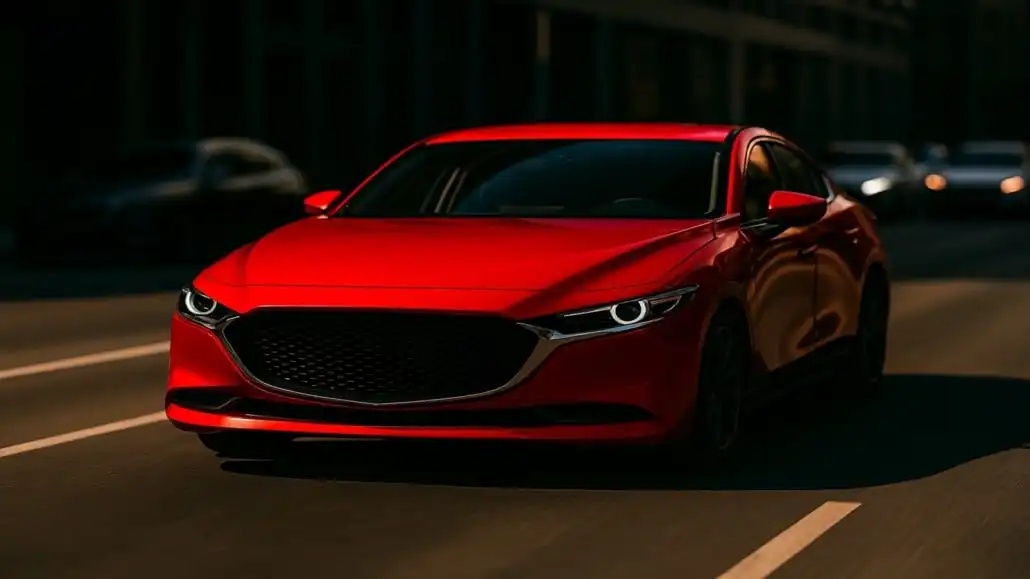
Red automotive paint: Why our brains notice red faster
Red car paint stands out because our eyes are tuned to red wavelengths — the same wiring that makes traffic lights grab us instantly. That vividness makes reds feel alive on the road, which is why automakers build halo reds with extra layers for glow.
Human visual acuity means red always stands out, which is why we explain how red works — so you understand what makes it distinctive, and what to keep in mind as an owner.
Why red grabs your eye
Red doesn’t just catch your eye — your whole nervous system treats it differently. Here’s what science says: Your vision is wired for red. Human eyes peak in the red range, tuned over millennia to notice ripe fruit, blood, and danger. That same wiring explains why traffic signals, stop signs, and brake lights are red — your visual system locks onto red more quickly than other wavelengths. On cars, this sensitivity makes reds look more striking on the road. Even a subtle half-shade variation between cars can stand out, which is why red paint feels so bold in motion.
Red travels further
Red sits at the long end of the visible spectrum — about 620–750 nanometers. Longer wavelengths scatter less than shorter ones, which is why red light reaches your eyes more clearly. That’s why sunsets glow red after other colors fade, why stoplights pierce through fog, and why red car paint feels so vivid in sunlight.
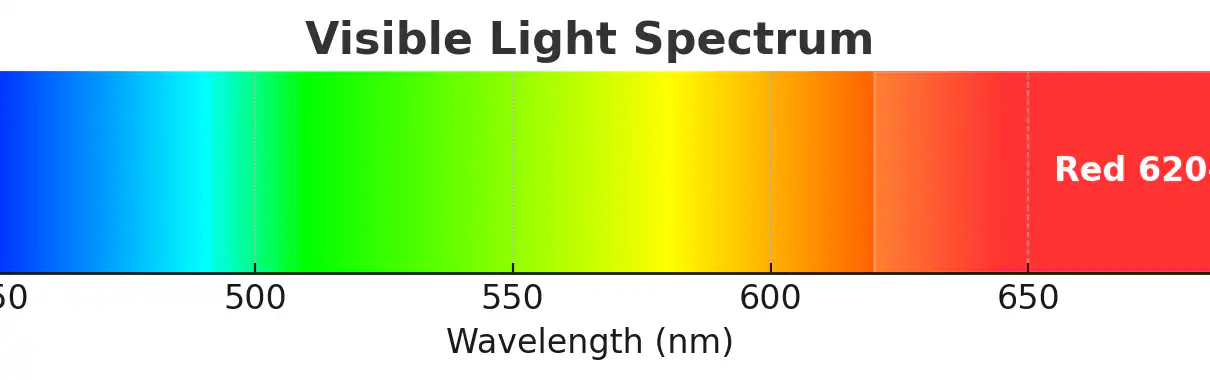
Visible light spectrum showing red’s long wavelength (620–750 nm).
Red feels more intense
Your body and brain react to red. As reported by Science Daily, researchers found that seeing red makes people react faster and more forcefully, even without realizing it. The color sparks an arousal response — priming muscles and sharpening awareness. Psychologist’s take: In visual search tests, a red object “pops out” immediately among neutral ones. Red is processed pre-attentively, meaning your brain flags it before conscious thought. On cars: This dual effect explains why red finishes feel alive — your eyes lock on, your body responds, and the car seems more dynamic than the same shape in any other color.
Red can almost glow
What people call a “halo red” isn’t a paint type — it’s a visual effect. Some reds, especially pearl and tri-coat finishes like Toyota Ruby Flare Pearl (3T3) or RAM Delmonico Red (PRV/NRV), use translucent red layers beneath clear coat. Light penetrates these layers, spreads slightly before reflecting back, and creates a warm glow around highlights and edges. Human vision exaggerates red edges, more than blues or greens. Solid reds, such as Honda Milano Red (R81), are more opaque and tend to look flatter by comparison. The “halo” isn’t a defect — it’s a byproduct of depth, layering, and how human vision exaggerates red contrast.
How automakers build halo reds
- Some halo hues: Ferrari Rosso Corsa, Mazda Soul Red Crystal, Acura Valencia Red Pearl. Brands pour their most advanced paint formulas into reds.
- How they do it: Reds often use tri-coat stacks (base ➝ tinted mid ➝ clear). This layering deepens chroma, giving that glowing, “alive” effect.
Famous halo reds
- Ferrari Rosso Corsa (300) — A racing icon turned brand identity.
- Mazda Soul Red Crystal (46V) — A multi-layer red known for depth and complexity.
- Acura Valencia Red Pearl (R-556P) — An NSX halo hue, carried into PMC (Performance Manufacturing Center) editions.
These paints became legends because they pushed engineering further — more layers, more tuning, more depth. They shine because that depth comes from multiple layers, which is why reds regain their richness as sufficient paint builds up.
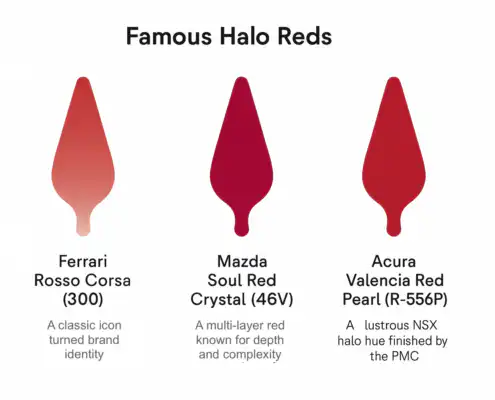
Comparison of three legendary reds — Ferrari Rosso Corsa (300), Mazda Soul Red Crystal (46V), and Acura Valencia Red Pearl (R-556P) — showing how advances in layering and pigment engineering add richness and depth to automotive color.
Four Rosso Corsa versions explained
When you search “Rosso Corsa,” you might see several similar Ferrari reds listed. They all trace back to Ferrari’s original racing color but they differ slightly by era, finish, and formulation:
- Rosso Corsa (300) — The classic Ferrari red, used on decades of Formula 1 and road cars. This is the shade most people think of as the Ferrari red. Rosso Corsa is a halo red not because of layering, but because of pigment intensity — a classic solid that set the standard before modern tri-coats existed.
- Rosso Corsa (322/205100/229120) — A modern reformulation of the same hue, tuned for newer base coat-clear coat systems. Visually, it’s almost identical to 300, just optimized for today’s paint chemistry.
- Rosso Corsa (322/231191) — A later production update for models using waterborne basecoats; very close in tone to the 322 but adjusted for environmental compliance and coverage.
- Rosso Corsa Metallizzato (205102/266165) — A metallic evolution of the classic color, adding fine aluminum flake for extra depth and reflectivity—it’s used on select recent Ferrari models and custom orders.
Each version carries Ferrari’s racing DNA. If you’re repairing or touching up, the paint code on your car’s VIN tag or inside the engine bay will tell you which Rosso Corsa your vehicle uses.
Red automotive paint — at a glance
- Coats: 4–5 light layers minimum, especially on tri-coats.
- Primer: Use the recommended primer — primer contrast changes tone.
- Lighting: Validate test cards in natural daylight.
- Fade: If the car is older, blend the adjacent panels to compensate for UV absorption.
Red paints aren’t difficult — they’re just vivid. Our eyes are tuned to notice red instantly, which makes the color feel more alive than any other on the road. With thin, even coats, the right primer, and a little care, red finishes keep their legendary glow for years. That’s why we explain how each color works — so you understand what makes it distinctive, and what to keep in mind as an owner.
FAQ: Red automotive paint
Yes. Reds absorb more UV, though modern stabilizers help. That’s why aged reds next to new paint often show mismatch.
Most red finishes reach full depth after 4–5 light coats, especially tri-coats.
While it’s a persistent myth, traffic data shows that red cars are not pulled over more frequently. Studies reveal that white vehicles receive the most traffic citations, with red often coming in second simply because they’re less common — not because they’re targeted. In reality, behavior, location, and vehicle type are the main predictors.
Related mixing videos (red series)
Watch: Factory-accurate red mixing demonstrations from our technicians.
Toyota Ruby Flare Pearl (3T3) — OEM Formula Color Mixing
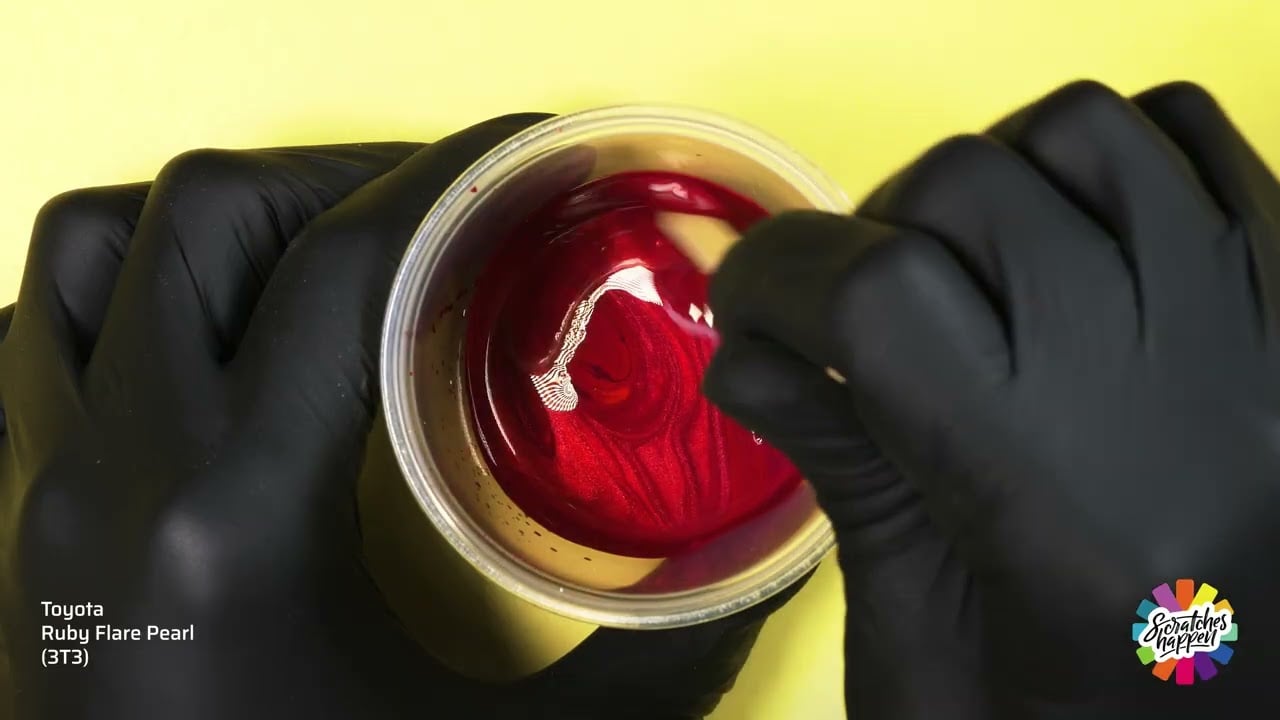
Red mixing playlist: Watch the full playlist on YouTube →
Related content
Discover more stories exploring color — and the allure and armor of automotive paint.
- From the Color Series:
- Series Hub: Why Color Matters: Introducing the ScratchesHappen Color Series – Explore the full Color Series and why color behaves the way it does.
- Silver/Grey Automotive Paint: Why They Change with Light and Angle→
- White Automotive Paint: From Basic Whites to Tri-Coat Finishes→
- Orange Automotive Paint: Why Some Blaze and Others Look Dull→
- Help Article: Applying Tri-Coat Layer 2 (L2 is a mid coat), Metallic or Pearl Finish Paint – Read how metallic and pearl coats are applied.
- Blog: Not All Car Colors Cover Equally: Why Red and Blue Paints Need Extra Coats→
- Tool: Scratch Match — Compare real paint scratch photos to choose the right repair kit →
- Explore: Color Red Increases the Speed and Strength of Reactions — ScienceDaily – Learn about the human biological reaction to red color.



Leave a Reply
Want to join the discussion?Feel free to contribute!