
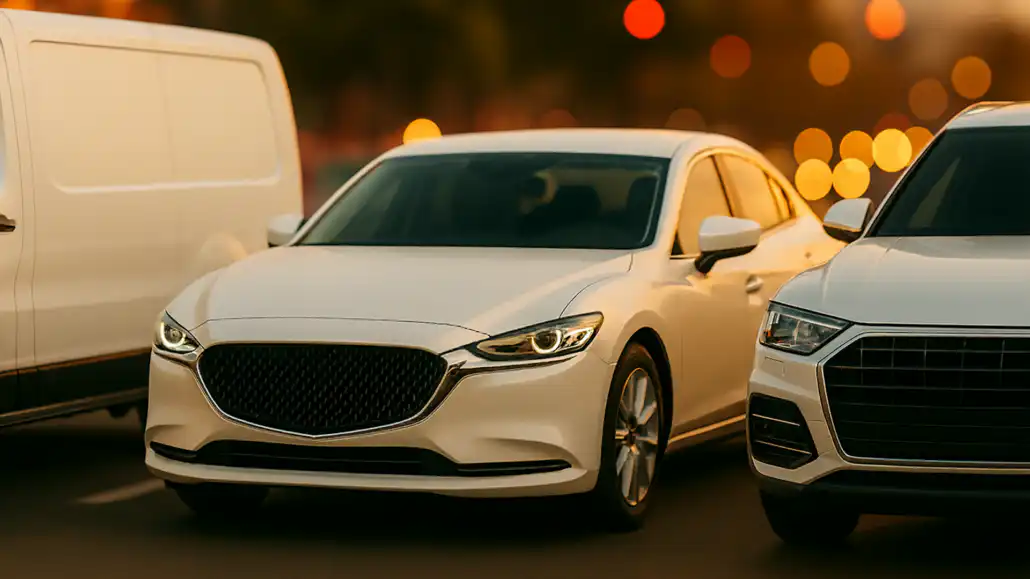
White automotive paint: How it ranges from basic whites to tri-coat finishes
From work vans to premium pearl vehicles, white paint ranges from plain solid whites that cover quickly to shimmering tri-coats with extra layers and depth. That wide spectrum makes white the most popular color on the road — and also the most misunderstood.
White cars dominate the road because they look clean, timeless, and modern — and accident data shows they are also the safest to drive, especially at night. But not all whites are alike: some are straightforward fleet solids, others are metallics with sparkle baked in, and many are shimmering tri-coats that shift in the light. That’s why we explain how white works — so you understand what makes it distinctive, and what to keep in mind as an owner.
How whites work
Solid white
High-opacity and straightforward. Fleet choices like Ford Cloud 9 White/Oxford White (YZ/M6466A/Z1/M6887A) cover fast, look clean, and are prized for practicality.
Metallic white
A single paint formula with metallic flakes built in. No separate pearl mid-layer. These finishes add a subtle sparkle. Examples include Volvo Cosmic White Metallic (481), Mercedes-Benz Digital White Metallic (144/6144/9144), and Chrysler White Gold Pearl (PWL/HWL) — a “pearl” in name, but actually a metallic, not a tri-coat. It achieves its warm shimmer with a metallic pigment added to the white paint rather than a layered pearl mid-coat.
Pearl white (tri-coat)
Most drivers know these as “pearl whites” — shimmering finishes that catch the light because of mica or ceramic particles. In reality, nearly all modern pearl whites are built as tri-coat systems: a solid base, a translucent pearl mid-layer, and a clear coat on top. Popular examples include Toyota Blizzard Pearl (070), Cadillac Crystal White (WA140X/G1W/WA472B/GE8), and Tesla Pearl White Multi-Coat (PPSW).
What is a tri-coat paint?
Think of a tri-coat as a paint sandwich:
- Top slice of bread = Clear coat (gloss + protection)
- Seals the sandwich so it holds together, protects the inside, and gives you the glossy, finished surface.
- Filling = Pearl mid-coat (the shimmer and sometimes tint)
- This is the “special sauce” layer. It’s often semi-see-through, and makes the sandwich interesting.
- Bottom slice of bread = Base coat (white opaque paint)
- The foundation layer, plain, sturdy, and sets the foundation.
That extra mid-layer is what makes “pearl whites” look special. In contrast, simple white paints only have the base coat of white paint and the clear coat.
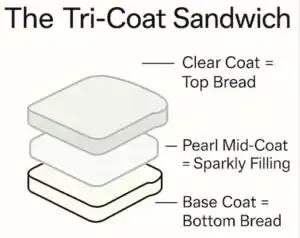
The tri-coat sandwich: Diagram of a tri-coat automotive paint system depicted as a sandwich. Bottom layer labeled “Base Coat = Bottom Bread,” middle layer labeled “Pearl Mid-Coat = Sparkly Filling,” and top layer labeled “Clear Coat = Top Bread.”
The science of white’s shimmer
White looks simple because it reflects the full visible spectrum — our eyes register “bright” when every wavelength bounces back at once. But in automotive paint, pure white pigments are rare. Most bright whites rely on titanium dioxide (TiO₂), a mineral that reflects and scatters light with exceptional efficiency. That’s why whites cover well and resist fading.
Premium whites add shimmer by introducing pearlescent or metallic effects. These rely on thin-film interference — the same effect that makes seashell nacre or soap bubbles iridescent. As light passes through translucent layers containing mica or ceramic flakes, some wavelengths are reflected while others pass through, creating depth and sparkle.
That layering is why whites like “Pearl” or “Crystal” don’t just look bright — they appear to glow or shift in motion, turning a seemingly simple color into one of the most technically sophisticated finishes on the road.
Why white took over the roads
- Most popular worldwide — Roughly 31% of all new cars sold in 2024 were white, according to Axalta’s Global Color Popularity Report. In North America, it’s even higher at 33%.
- Half solids, half pearls — Of that total, about half were solid whites (17%) and half were pearl or tri-coat whites (14% globally, 16% in North America). That balance explains why “white” can mean anything from a simple fleet finish to a shimmering premium upgrade.
- Practical perks — White reflects heat, hides dust, and holds resale value thanks to broad appeal.
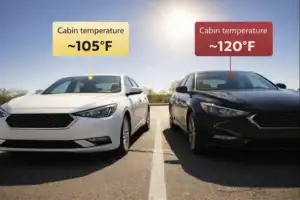
Illustrative example of white and black cars in high summer sun. Actual cabin temperatures vary based on sunlight, time of day, ventilation, and interior materials.
The science of white: Why it feels “easy”
- Reflects heat → White paint has a high albedo, meaning it reflects most sunlight instead of absorbing it. In hot sun, a white car’s cabin can run 10–15°F cooler than a black car.
- Hides dust → Dust and pollen are usually gray or beige. On white, the low contrast makes them blend in; on black or navy, every speck pops.
- Stays new-looking → White pigments rely on titanium dioxide (TiO₂), the same mineral used in sunscreen. TiO₂ is highly UV-stable, so it reflects and scatters sunlight instead of breaking down. That means white paint resists fading far better than reds or blues, keeping the finish bright and resistant to UV yellowing. It’s also why white pigment is so opaque: TiO₂ has one of the highest refractive indices of any known material, which is why it covers so well in fewer coats than, say, reds or blues.
- Micro-scratches → Because scratches scatter light, they’re less visible on a bright surface than on dark glossy paint.
Bottom line: White buys you time — it looks cleaner, cooler, and fresher, even when real-world wear and tear is setting in.
Myths about white
- “White is cheap.” — Not always. Solids are common in fleets, but pearls and tri-coats are premium upgrades that cost more to produce.
- “White is easy.” — Fleet solids are simple; tri-coats need the extra mid-coat layer.
- “White shows dirt.” — Actually, it hides light dust and pollen better than dark paints. Black cars show every spot — white buys you time between washes.
White automotive paint — at a glance
- Solids vs pearls: Solids cover quickly; pearls (tri-coats) require a few more coats of the mid-coat for depth and color match.
- Application: Always think base → mid → clear when repairing tri-coats.
- Testing: Always spray test cards in daylight before applying to panels.
- Aging: Clear coat health is crucial; pearls can yellow slightly if neglected. To keep them bright: wash regularly with pH-balanced soap, dry with microfiber to avoid water spots, and protect the clear with wax, sealant, or ceramic coating. Shade or garage storage slows UV wear, and fixing chips promptly prevents edges of the clear from lifting.
White paints aren’t difficult — they’re often layered though. Solids deliver timeless simplicity, while pearls and tri-coats add sophistication and shimmer. With thin, even coats and a well-cared-for clear, white finishes hold their elegance for years. That’s why we explain how each color works — so you see what makes it distinctive, and what to keep in mind as an owner.
FAQ: White automotive paint
Yes. Dust and water spots show less on white than on darker paints, which is part of white’s lasting popularity.
The translucent mid-layer can warm in tone if the clear coat oxidizes, so upkeep and protection matter.
Solid whites are usually straightforward; tri-coats include the extra mid-coat paint that restores depth.
Related mixing videos (white series)
Watch: Factory-accurate white mixing demonstrations from our technicians.
Ford Oxford White (YZ/Z1) — OEM Formula Color Mixing

Tesla Pearl White Multi Coat (PPSW) — OEM Formula Color Mixing

White mixing playlist: Watch the full playlist on YouTube →
Related content
Discover more stories exploring color — and the allure and armor of automotive paint.
- From the Color Series:
- Series Hub: Why Color Matters: Introducing the ScratchesHappen Color Series – Explore the full Color Series and why color behaves the way it does.
- Silver/Grey Automotive Paint: Why They Change with Light and Angle→
- Red Automotive Paint: Why Our Brains Notice Red Faster→
- Help Article: Applying Tri-Coat Layer 2, Metallic or Pearl Finish Paint – Read how metallic and pearl finishes are applied.
- Tool: Scratch Match — Compare real paint scratch photos to choose the right repair kit →
- Explore: Axalta’s 2024 Global Automotive Color Popularity Report – See more detail about popular colors by region.



Leave a Reply
Want to join the discussion?Feel free to contribute!