
Orange automotive paint: Why some blaze and others look dull
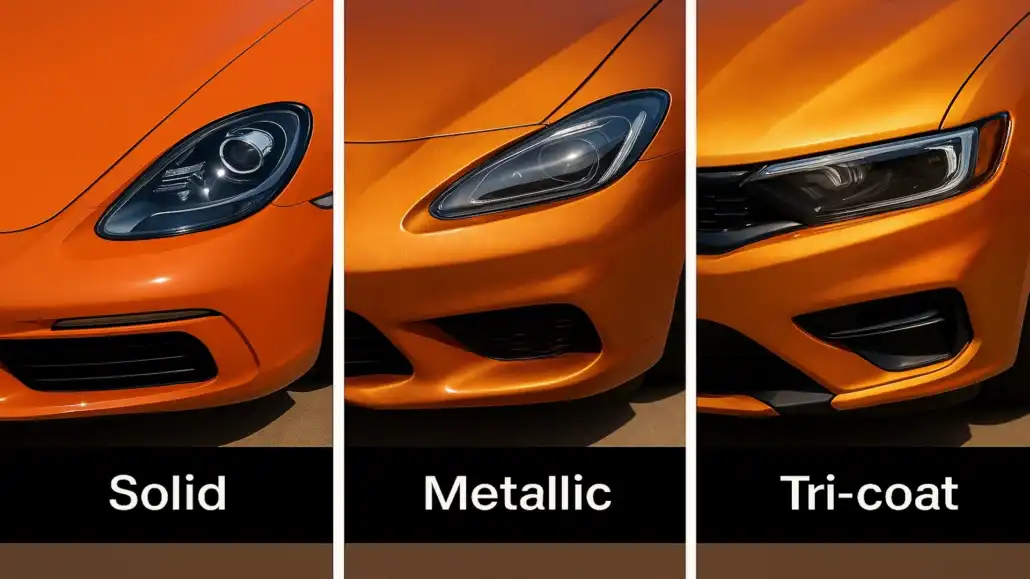
Why does one orange car blaze like neon while another looks dull? Finish and light make the first difference — solids, metallics, pearls, and tri-coats all bend light differently, stacking depth or sparkle. Over time, aging clear coat mutes even vivid oranges, upsetting our assumption that orange should always pop.
From traffic cones to sunsets, it’s wired into our sense of attention: orange should glow. So when a car’s orange paint looks subdued instead of blazing, it feels unexpected. That’s why we explain how orange works — so you understand what makes it distinctive, and what to keep in mind as an owner.
Why some oranges glow (and others don’t)
- Solid color: Straight pigment, like a sheet of orange paper — bold but flatter.
- Metallic color: Tiny flakes act like glitter, sparkling as the panel catches light.
- Pearl color: Special particles scatter light, giving a soft shimmer that changes with angle.
- Tri-coat color: A solid base layer, a tinted mid-coat, and a clear top layer together creating a candy-like depth and the most explosive glow.
Other factors:
- Light and angle. Viewed straight on, an orange may shine bright; from the side, it can look darker or muted.
- Primer sets the mood. Over light grounds, orange looks brighter; over dark, it deepens.
- Clear coat determines sheen. A healthy clear coat amplifies whatever the color layer is doing; a hazed or oxidized clear mutes it.
- UV on warm pigments. Orange sits with reds/yellows in the UV-sensitive family. Modern PO36/PO73 pigments are stable, but gradual fade is normal.
That baseline difference is only half the story. The other half comes from what time and exposure do to orange.
Watch how orange pigment behaves during mixing
This video shows McLaren Orange (paint code 2311), often called Papaya Orange in McLaren’s branding. As the pigments blend, you can see how orange builds warmth, intensity, and depth before it’s ever applied to a car.
Why orange grabs our attention
Orange feels like it glows because of how our eyes process it. Sitting between red and green wavelengths, it stimulates both sets of cones at once, which makes the signal feel unusually vivid — almost buzzing with energy. On top of that, orange is relatively rare in natural backgrounds like grass, trees, or sky, so when it appears, the contrast grabs our attention. Because it’s the color of fire and sunsets, our brains connect orange with warmth, energy, and transience. That’s why orange paint can seem alive, like it’s glowing even when still.
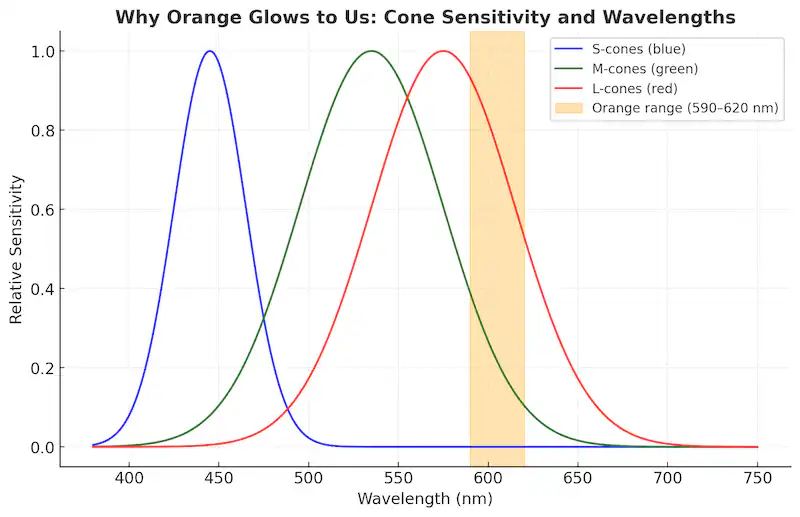
Think of the three overlapping sensitivity curves like three “radio stations” in your eyes: blue, green, and red. Each one is tuned to a different wavelength of light, but for orange, their signals overlap instead of cutting off cleanly. Orange light (590–620 nm) falls right in the overlap where the red and green stations (cones) are both playing strong. That means your brain is hearing two stations at once — a boosted signal — which is why orange feels so intense and almost “glowing.”
Orange pigment chemistry
- Back in the day: The brightest oranges ran on lead “molybdate” — vivid but toxic.
- Modern magic: Today’s PO36 and PO73 pigments give the same fire without the heavy metals.
- Light tricks: Metallic flakes and pearl pigments bend light like mirrors and soap bubbles, stacking depth into the color.
- Neon heartbreak: The sun kills fluorescent orange. The shade that most resembles sunlight is the one UV rays fade the fastest — which is why OEMs don’t offer it.
Iconic oranges you know (and we sell)
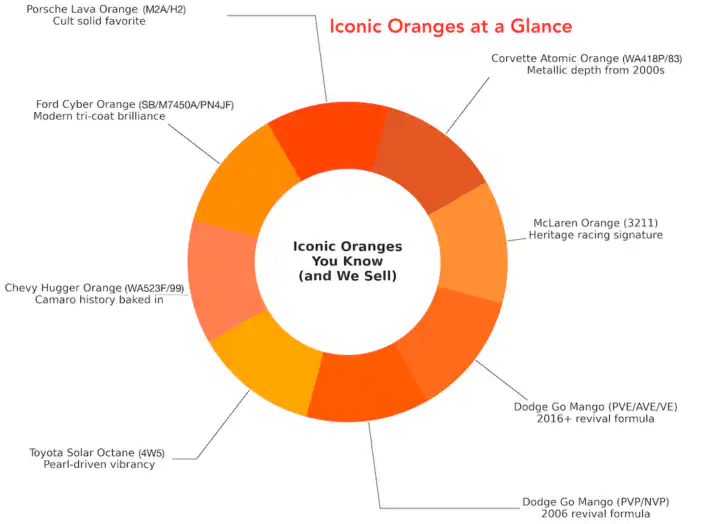
These aren’t just shades, they’re icons. Here are some of the most recognizable orange paints we match and sell every day:
- McLaren McLaren Orange (3211) – Heritage racing signature
- Corvette Atomic Orange Metallic (WA418P/83) – Metallic depth from 2000s
- Porsche Lava Orange (M2A/H2) – Cult solid favorite
- Ford Cyber Orange Metallic (SB/M7450A/PN4JF) – Modern tri-coat brilliance
- Chevy Hugger Orange (WA523F/99) – Camaro history baked in
- Toyota Solar Octane (4W5) – Pearl-driven vibrancy
- Dodge Go Mango (PVP/NVP) – 2006 revival formula
- Dodge Go Mango (PVE/AVE/VE) – 2016+ revival formula
Why are there two Go Mangos?
These orange colors are officially called Go Mango, but they’re different paints. That’s why your paint code matters more than the color name — two cars wearing “Go Mango” might not match unless the paint code matches too.
- 1970—Dodge first launched Go Mango as a High-Impact color in 1970.
- 2006—When it came back in 2006, the formula changed to meet modern paint standards: that’s the PVP/NVP code.
- 2016—Then in 2016, Dodge updated it again, this time with the PVE/AVE/VE code.
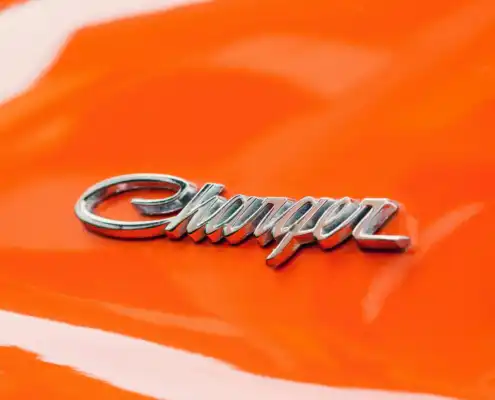
Photo by Filippo Andolfatto on Unsplash
Orange automotive paint — at a glance
- Expect some color shift. Oranges, especially metallics and tri-coats, will look a little different under shop lights vs. sunlight.
- Layer carefully. For tri-coats, apply the color in multiple thin passes; the match develops as the layers build.
- Check in daylight. Always confirm on a test card outdoors.
- Clear coat is the unifier. A healthy clear coat locks gloss; a degraded one mutes it.
Orange is expressive. Solids, metallics, pearls, and tri-coats each set a different baseline, and light plus time decide whether orange blazes or reads more subdued. Because our eyes register orange with a boosted signal, it feels unusually vivid. That’s why when orange blazes, it delivers on its built-in promise of vibrancy — and why when it looks muted, it’s not failure but expectation meeting reality. That’s why we explain how each color works — so you understand what makes it distinctive, and what to keep in mind as an owner.
FAQ: Orange automotive paint
Two main culprits: clear coat haze/oxidation and normal UV fade in warm pigments. Restoring clear gloss often revives the color beneath.
No. Some, like Porsche Lava Orange, are solids. Tri-coats just add extra glow.
Indoor lighting often lacks the full spectrum of daylight, so the color leans muted. Step outside to see the true hue.
Standard OEM oranges are about as stable as reds and yellows. Only neon or fluorescent oranges fade quickly, which is why they’re avoided in OEM palettes.
Related content
Discover more stories exploring color — and the allure and armor of automotive paint.
- From the Color Series:
- Series Hub: Why Color Matters: Introducing the ScratchesHappen Color Series – Explore the full Color Series and why color behaves the way it does.
- Silver/Grey Automotive Paint: Why They Change with Light and Angle→
- Red Automotive Paint: Why Our Brains Notice Red Faster→
- Help Article: Applying Tri-Coat Layer 2 (L2 is a mid coat), Metallic or Pearl Finish Paint – Read how metallic and pearl coats are applied.
- Blog: Not All Car Colors Cover Equally: Why Red and Blue Paints Need Extra Coats→
- Tool: Scratch Match — Compare real paint scratch photos to choose the right repair kit →
- Explore: Introduction to Human Vision and Color Perception — Evident Scientific – Read more about how humans perceive color.


Leave a Reply
Want to join the discussion?Feel free to contribute!