

How science at small scale shapes the look of your Acura
When particles shrink to the nanoscale, they stop behaving like their larger cousins — gold turns red, paint colors gain unusual depth. Acura’s Premium Paints use nanopigments to give finishes like Platinum White Pearl and Urban Gray Pearl a richer, more lustrous appearance.
The world feels like it’s changing faster than anyone can keep up. That pace isn’t new — in the space-race era, NASA had to find ways to educate the public about technologies no one had words for yet. (The movie Fly Me to the Moon riffs on this problem.) Industry has always needed to bridge that gap. After WWI, through the Cold War, into the 1990s — explaining technology to the public was part of progress.
Car paint is no different. Our paint expertise helps us describe how the finish on your car isn’t just chemistry; it’s science at a scale most people never think about. And when things get small — nano small — they stop behaving the way you’d expect. That’s the real story behind nanopigments in Acura’s Premium Paints. The hero image here presents a macro look at metallic paint under angled light — where nanopigments bend and scatter color.
What are nanopigments?
Nanopigments are colorants engineered at the nanoscale — measured in billionths of a meter. At this size, particles scatter and absorb light differently than conventional pigment flakes. In paint, that means:
- More vibrancy: Colors appear deeper and more saturated without looking muddy.
- Sharper highlights: Metallics and pearls show cleaner edges where light meets shadow.
- Longevity: Nano-scale uniformity helps resist fading from UV exposure.
In Acura’s Premium Paint formulas, nanopigments are combined with mica flakes in a single paint formula. The result is finishes like Platinum White Pearl (NH-883P) — a true tri-coat — and Urban Gray Pearl (NH-912P) — a single-formula pearl — that both show unusual depth compared to standard metallics.
Examples in Acura’s lineup
- Acura Platinum White Pearl (NH-883P) Touch Up Paint — a true tri-coat, requiring a ground coat and a mid-coat before clear. Nanopigments in the mid-coat add a pearl glow that shifts under light.
- Acura Urban Gray Pearl (NH-912P) Touch Up Paint — a single-formula pearl that contains mica and nanopigments in one paint mix. Even without a separate mid-coat, it shows a smooth, lustrous finish.
- Acura Adriatic Sea Blue Metallic (B-593M) Touch Up Paint — though not a tri-coat, its metallics benefit from nano-enhanced clarity.
These paints look richer because of how light interacts with the nano-enhanced layers, not just because of the base color recipe.
Beyond cars: Nanotech is everywhere
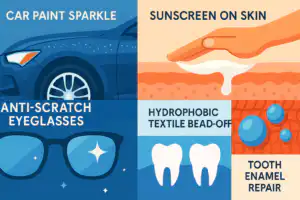
Nanopigments aren’t just in automotive paints. Nanotechnology has quietly become part of everyday life:
- Sunscreen — Zinc oxide nanoparticles block UV without leaving a white film.
- Eyeglass coatings — Nano-layers add scratch and fog resistance.
- Textiles — Stain-repellent nano-coatings keep fabrics cleaner.
- Toothpaste — Nano-hydroxyapatite helps repair tooth enamel.
In coatings, nano-scale additives are used in aerospace for durability, in electronics for anti-reflective surfaces, and in architecture for self-cleaning facades.
Nanopigments show how automotive paint has become a quiet frontier of nanotechnology. They don’t replace traditional pigments — they refine them, creating finishes that look deeper and last longer. From cars to sunglasses to sunscreen, the nano-scale is shaping how color and surfaces work in our world. That’s why we explain how each innovation works — so you understand what makes it distinctive, and what to keep in mind as an owner.
FAQ: From NASA to nanopigments
Not entirely. They’re enhancers. Nanopigments interact with light to refine clarity and vibrancy, but the hue still comes from traditional colorants.
No. Acura highlights nanopigments in its Premium Paint Technology colors — most commonly pearl whites and silvers.
Nanopigments have been in industrial coatings since the mid-2000s and widely marketed in automotive paints since the 2010s.
Not if you match by paint code. Our kits for tri-coats (like Platinum White Pearl) include both base and mid-coats, while single-formula pearls (like Urban Gray Pearl) come in one bottle.
Related content
- Model: Acura NSX Touch Up Paint – Read about the NSX and its legacy.
- Brand: Acura Touch Up Paint – Explore every Acura color.
- From the Color Series:
- Series Hub: Why Color Matters: Introducing the ScratchesHappen Color Series – Explore the full Color Series and why color behaves the way it does.
- White Automotive Paint: From Basic Whites to Tri-Coat Finishes→
- Watch: White Automotive Paint Mixing Playlist – Watch our team mix OEM white paints step by step (YouTube).
- Explore: Best Factory Paint Job Acura NSX? 18 mil of Paint! by AMMO NYC — a tour of the NSX paint process. (YouTube).



Leave a Reply
Want to join the discussion?Feel free to contribute!